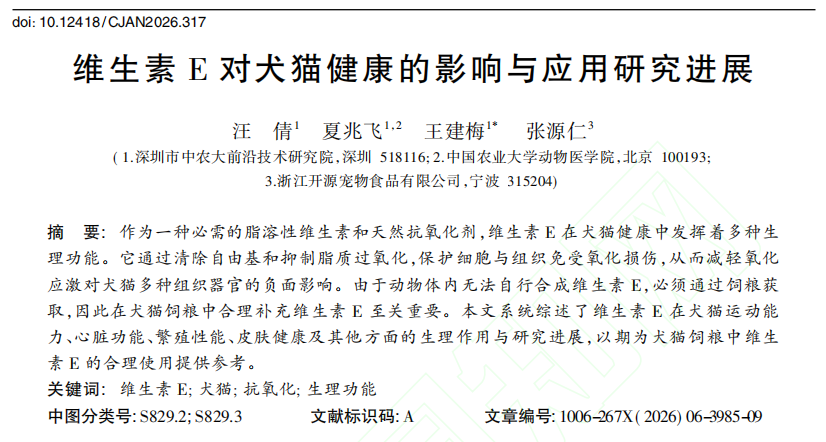
Recently, our company joined forces with the Institute of Frontier Technology of Shenzhen Central Agricultural University, the School of Zoological Medicine of China Agricultural University and other units to publish "Research Progress on the Impact and Application of Vitamin E on the Health of Dogs and Cats" online in the Journal of Animal Nutrition. This article systematically reviews the research progress of vitamin E in sports ability, heart function, reproductive performance, skin and subcutaneous tissue health of dogs and cats, and provides reference for the scientific application of vitamin E in dog and cat nutrition and pet staple foods.
Article

When looking at cat food and dog food formulas, many pet owners pay attention to meat content, protein, fat, and palatability, but they easily overlook a very important nutrient component-vitamin E.
Recently, our company (Zhejiang Kaiyuan Pet Food Co., Ltd.), in conjunction with the Institute of Frontier Technology of Shenzhen Central Agricultural University, the School of Zoology of China Agricultural University and other units, published the paper "Impact of Vitamin E on the Health of Dogs and Cats and Progress in Application Research" online on the "Journal of Animal Nutrition". This article systematically reviews the research progress of vitamin E in sports ability, heart function, reproductive performance, skin and subcutaneous tissue health of dogs and cats, and also provides reference for the rational application of vitamin E in staple foods of dogs and cats.
1. Why is vitamin E important to dogs and cats?
Vitamin E is not a single chemical substance, but a group of fat-soluble compounds with vitamin E activity. The paper mentioned that there are eight isomers of natural vitamin E, including α, β, γ, δ tocopherol and α, β, γ, δ tocotrienol. Among them, alpha-tocopherol is the most concerned form in current research and nutritional evaluation. From the perspective of dog and cat nutrition, the importance of vitamin E is mainly reflected in two aspects:
First, it is an essential fat-soluble vitamin for dogs and cats. Dogs and cats cannot synthesize vitamin E on their own and need to be obtained through daily diet.
Second, it has antioxidant nutritional effects. Vitamin E can reduce the negative effects of oxidative stress on tissues and organs by clearing free radicals and inhibiting lipid peroxidation.
This also explains why vitamin E is not an optional "conceptual ingredient" in dog and cat staple food formulas, but a basic nutritional design closely related to daily nutritional support, body antioxidant defense, oil stability and other issues.
2. Why is natural vitamin E worth paying attention to?
The paper mentioned that natural vitamin E is not a single component, but a group of fat-soluble compounds with vitamin E activity, including a variety of tocopherols and tocotrienols. Among them, alpha-tocopherol is a very important form in current research and nutritional evaluation.
The naturally occurring α-tocopherol is RRR-α-tocopherol, also often referred to as d-α-tocopherol; while the artificially synthesized α-tocopherol, or dl-α-tocopherol, is a mixture of multiple stereoisomers. The bioavailability of natural α-tocopherol was higher than that of synthetic α-tocopherol because of different recognition and utilization of different structural forms.
This also shows that the value of natural vitamin E is not only "natural source", but also related to its structural form, body recognition and nutritional utilization. For cat food dog food, the choice of natural vitamin E is not simply to emphasize "natural sources", but more importantly, to make vitamin E play a stable and sustained antioxidant nutritional support role in daily staple foods.
III. What is the relationship between vitamin E and the stability of oils in staple foods?
Cat food dog food usually contains animal fat, fish oil, vegetable oil and other oil sources. These oils provide energy and flavor to dogs and cats, and also affect the palatability of staple foods.
But oils, especially polyunsaturated fatty acids, are susceptible to oxidation. The paper pointed out that vitamin E, as a natural antioxidant, can on the one hand help inhibit the oxidative deterioration of polyunsaturated fatty acids in diet during storage, and on the other hand, it can also meet the internal antioxidant needs of dogs and cats after absorption.
Therefore, paying attention to vitamin E in the formula of staple foods is not only to "supplement a vitamin", but also to form a more complete design of staple foods in terms of nutritional supply, oil stability, and long-term feeding.
4. What are the research directions of vitamin E on dog and cat health?
The paper summarizes the research progress of vitamin E in multiple dog and cat health directions, including exercise ability, heart function, reproductive performance, skin and subcutaneous tissue health, immunity, retina, joints and kidneys.
In terms of exercise, some dog studies have shown that vitamin E supplementation can help reduce oxidative damage caused by exercise and support the antioxidant defense system. There are few direct studies on cats, but studies have suggested that vitamin E has a certain relationship with cat.
In terms of skin and subcutaneous tissue health, the paper mentioned that vitamin E, as a natural antioxidant, can help protect the skin from the adverse effects of oxidative stress. For cats, long-term intake of diets high in polyunsaturated fatty acids and insufficient vitamin E may be related to nutrition-related problems such as panlipitis.
These studies show that vitamin E has multiple values in dog and cat nutrition. Its significance is not to create "immediate" effects, but to continue to participate in antioxidant nutritional support through daily diet to help cats and dogs obtain more stable nutritional protection during long-term feeding.
5. Summarize
that the main food is the food that cats and dogs eat every day. For long-term feeding products, we should not only look at short-term palatability, but also pay attention to whether the nutrition is stable, whether the formula is complete, and whether the oil is reasonably protected.
It can be seen from this research progress that the value of vitamin E to the health of dogs and cats is mainly reflected in four aspects:
First, it is a fat-soluble vitamin that dogs and cats must obtain from diet(simply put, cats and dogs cannot synthesize vitamin E themselves and needs to be supplemented by the main diet they eat every day.) 。
Second, it participates in the body's antioxidant nutritional support and helps inhibit lipid peroxidation(that is, vitamin E can help maintain the body's antioxidant balance and reduce the impact of oxidative stress). 。
Third, it is related to the stability of oil in staple foods, storage stability and long-term feeding experience(Cat dog food usually contains fat and oil components, and reasonable addition of vitamin E helps pay attention to the stability of oil during storage.) 。
Fourth, it is also related to the scientific consideration of changes in nutritional needs of dogs and cats at different life stages(different stages such as childhood, adulthood, and reproductive period, the demand for vitamin E may differ, and the formula design needs to be adjusted based on actual nutritional needs).
From the perspective of natural vitamin E, the paper's research on the differences in structural form and bioavailability between natural α-tocopherol and synthetic α-tocopherol provides a scientific reference for the application of natural vitamin E in dog and cat nutrition. The value of natural vitamin E is not only reflected in its source characteristics, but also closely related to its structural form, body utilization and nutritional functions.
For pet staple foods, natural vitamin E is not a simple formula label, but a nutritional design based on the long-term nutritional needs of dogs and cats and the quality stability of staple foods. By rational application of natural vitamin E, it can help build a more complete antioxidant nutrition system and provide more stable nutritional support for long-term healthy feeding of dogs and cats.
PROFILE Wang Qian: Doctoral candidate. |PROFILE
- 汪倩:博士研究生。It is mainly engaged in research on nutrition and functional additives for dogs and cats, focusing on the metabolism, physiological effects and feed application of vitamin antioxidant nutrients in companion animals, conducting reviews and animal experimental research, participating in a number of pet nutrition-related topics, and systematically sorting out the domestic and foreign research progress of natural vitamin E in the fields of skin care, reproductive performance, anti-aging, and immunity enhancement of dogs and cats, providing theoretical support for the formulation of pet staple foods and functional nutritional supplements.
 References for the century-old development of cultural walls at the School of Zoology, China Agricultural University
Wang Qian, Xia Zhaofei, Wang Jianmei, Zhang Yuanren. Research progress on the impact of vitamin E on the health of dogs and cats and its application [J/OL]. Journal of Animal Nutrition, 2026, 38(6): 3985-3993